

Listen to this article
Tap play — works on desktop and mobile
To calculate your ovulation date, subtract 14 days from the first day of your next expected period. For example, if your cycle is 30 days and your last period started June 1, you ovulate around June 17. Use an ovulation calculator to get your fertile window instantly. Pair the calculation with signs like egg-white cervical mucus and a basal body temperature rise for the most accurate picture of when you're ovulating.
If you've been trying to conceive — or just want to understand your body better — knowing when you ovulate is one of the most useful things you can learn. But between apps, fertility charts, and advice from well-meaning relatives, it's easy to feel overwhelmed. Here's what you actually need to know.
What Is Ovulation, and Why Does the Date Matter?
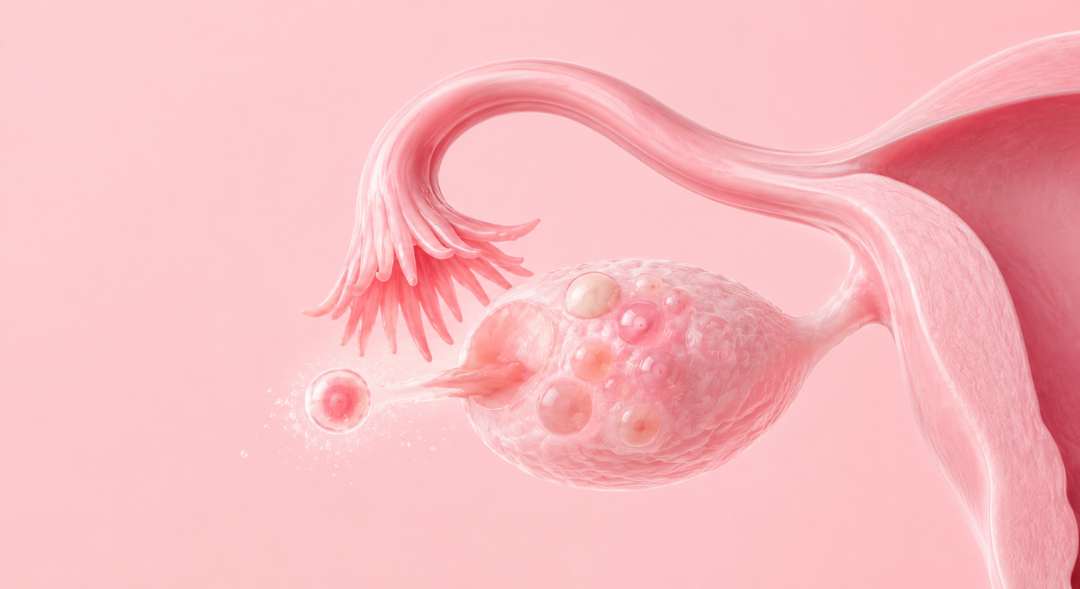
Ovulation is when a mature egg is released from one of your ovaries. That egg can only be fertilized for about 12 to 24 hours after release. But here's the thing — sperm can survive inside the body for up to 5 days. That's why the 5 days leading up to ovulation and the day of ovulation itself make up what's called the fertile window.
Miss that window, and pregnancy isn't possible that cycle. Know it, and you're working with your biology instead of guessing.
How to Use an Ovulation Calculator
The fastest way to estimate your ovulation date is with an ovulation calculator. You enter two things:
The first day of your last menstrual period (LMP)
Your average cycle length (typically 21–35 days)
The calculator then predicts when you'll ovulate and highlights your fertile window. Most women with a 28-day cycle ovulate around Day 14 — but that's just an average, not a rule.
Try it now: Use an ovulation calculator to find your estimated fertile window based on your last period and cycle length.
The Manual Method: How to Calculate It Yourself
You don't need an app to figure this out. The math is simple:
Ovulation Date = First Day of Next Expected Period − 14 Days
Here's how to find your next expected period:
Next Period = First Day of Last Period + Your Cycle Length
Example:
Last period started: June 1
Cycle length: 30 days
Next expected period: July 1
Ovulation estimate: June 17 (July 1 − 14 days)
Why subtract 14? Because the luteal phase — the time between ovulation and your next period — is almost always 12 to 16 days, regardless of how long your overall cycle is. It's the phase before ovulation that varies from person to person.
What If Your Cycle Is Irregular?
Irregular cycles make prediction harder, but not impossible. Here's what helps:
Track your cycle for 3–6 months. Add up the number of days in each cycle, then divide by the number of cycles to get your average.
Look for patterns. Even if your cycles vary between 26 and 32 days, there's often a range within which you ovulate. Your fertile window just becomes a bit wider.
Use physical signs alongside the calendar. Your body gives signals — you just need to know what to look for.
Signs Your Body Gives You Around Ovulation
These physical cues are often more reliable than calendar math alone:
Cervical mucus changes. In the days before ovulation, discharge becomes clearer, stretchier, and slippery — often compared to raw egg whites. This is a key sign that ovulation is near.
Basal Body Temperature (BBT) shift. Your resting temperature rises slightly (about 0.2°C) after ovulation, which confirms it happened. Track it daily first thing in the morning before getting up.
Mild pelvic pain. Some women feel a dull ache or twinge on one side of the lower abdomen around ovulation. This is called mittelschmerz (German for "middle pain").
Increased libido. Not a coincidence — this is your body nudging you toward reproduction at the right time.
Breast tenderness or bloating. Hormonal shifts before and after ovulation can cause these temporary changes.
Ovulation Predictor Kits (OPKs): The Science-Backed Option
Ovulation predictor kits detect the surge in luteinizing hormone (LH) that triggers egg release — typically 24 to 36 hours before ovulation. They work like a pregnancy test: pee on a stick, read the result.
OPKs are especially useful if:
Your cycles are irregular
You've been trying to conceive for a few months without success
You want confirmation beyond calendar tracking
One thing to note: a positive OPK means the LH surge is happening, not that you've already ovulated. Time intercourse within the next 24 to 36 hours for the best chance.
How Cycle Length Affects Your Ovulation Date
Cycle Length | Estimated Ovulation Day |
|---|---|
21 days | Day 7 |
24 days | Day 10 |
28 days | Day 14 |
30 days | Day 16 |
35 days | Day 21 |
These are estimates. Every body is different, and stress, illness, travel, or changes in sleep can shift ovulation earlier or later in a given month.
Common Mistakes People Make When Tracking Ovulation
Assuming Day 14 applies to everyone. It's the average for a 28-day cycle — not a universal truth. If your cycle is 32 days, you're likely ovulating around Day 18.
Only tracking for one month. Patterns become clearer over several cycles. One month of data is a starting point, not a conclusion.
Ignoring lifestyle factors. High stress, extreme exercise, significant weight changes, and poor sleep can all delay or disrupt ovulation.
Relying on apps blindly. Period tracking apps predict based on your history. If your data is sparse or inconsistent, their estimates will be too.
When to Talk to a Doctor
If you've been tracking carefully and still aren't seeing clear signs of ovulation — or if your cycles are very irregular (under 21 days or over 35 days) — it's worth talking to a gynecologist or fertility specialist. Conditions like PCOS (polycystic ovary syndrome) and thyroid disorders can affect ovulation, and they're very treatable when caught early.
The Bottom Line
Calculating your ovulation date doesn't require a medical degree or an expensive gadget. Start with the formula, use an ovulation calculator to double-check, watch for your body's natural signs, and give yourself a few months to find your personal pattern. The more consistently you track, the clearer the picture becomes — and the better positioned you'll be, whether you're trying to conceive or simply trying to understand your own cycle.

